




Long knife strokes do more of the work for you, which is why professional cooks and serious home cooks often step up to a 240mm gyuto. The extra length lets you slice a brisket or a whole squash in fewer passes and push through big batches of vegetables with less effort.
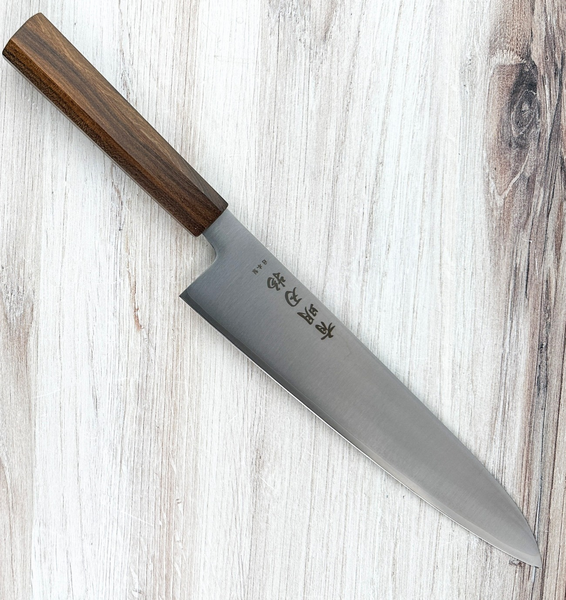
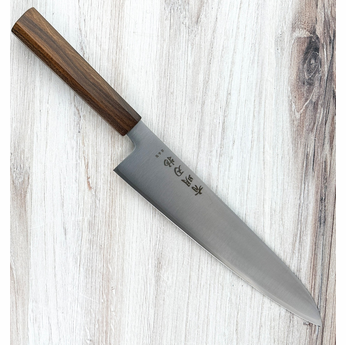
This Ariake gyuto is forged in a san mai, or three-layer, construction with an AUS10 stainless core and stainless cladding. The core is hardened to about 61 HRC, hard enough to hold a refined edge through a long service, while AUS10 keeps sharpening quick and approachable on water stones.
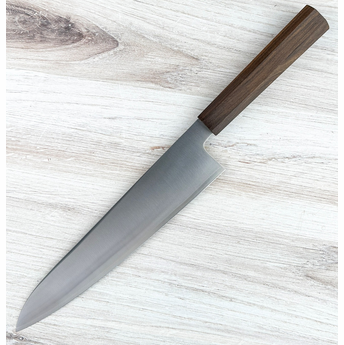
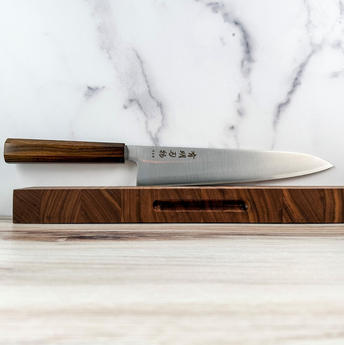
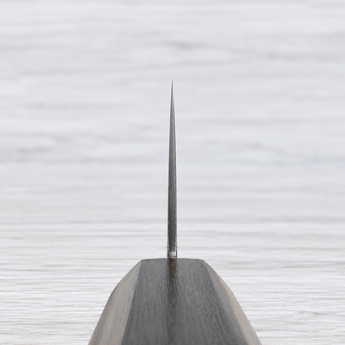
An octagonal walnut handle without a ferrule keeps the knife from feeling heavy despite its length. Ariake knives are made in Saga Prefecture and named for the Ariake Sea, and the 240mm is the largest gyuto in the line.
Care Instructions: AUS10 is a stainless steel, so it shrugs off the spotting and patina that carbon blades develop, but it still deserves a quick hand wash and a towel dry right after use. Keep it out of the dishwasher, which is hard on both the edge and the walnut handle. Cut on wood or rubber boards, skip frozen foods and twisting cuts, and touch up the edge on a fine water stone when it starts to slip on tomato skins.Brand: Ariake
Location: Saga Prefecture, Japan
Construction: San Mai (3 Layer)
Edge Steel: AUS10 Stainless Steel
Cladding: Stainless Steel
HRC: 61
Handle: Octagonal Walnut
Weight: 5.9 oz (168 g)
Blade Length: 242 mm
Total Length: 404 mm
Spine Thickness at Base: 2 mm
Blade Height: 50 mm
This Ariake gyuto is forged in a san mai, or three-layer, construction with an AUS10 stainless core and stainless cladding. The core is hardened to about 61 HRC, hard enough to hold a refined edge through a long service, while AUS10 keeps sharpening quick and approachable on water stones.
An octagonal walnut handle without a ferrule keeps the knife from feeling heavy despite its length. Ariake knives are made in Saga Prefecture and named for the Ariake Sea, and the 240mm is the largest gyuto in the line.
Care Instructions: AUS10 is a stainless steel, so it shrugs off the spotting and patina that carbon blades develop, but it still deserves a quick hand wash and a towel dry right after use. Keep it out of the dishwasher, which is hard on both the edge and the walnut handle. Cut on wood or rubber boards, skip frozen foods and twisting cuts, and touch up the edge on a fine water stone when it starts to slip on tomato skins.




